Medical Aesthetics Practice Growth Strategy
If your medical aesthetics or wellness practice always seems busy with marketing – posting, advertising, promoting, adding services – but the results feel inconsistent, the problem probably isn’t the tactics.
The problem is that the tactics aren’t connected to a strategy.
Strategy isn’t a marketing plan. It’s every decision about where your business is headed. And once those decisions are made, your marketing stops feeling like guesswork.
Ask most practice owners about their growth strategy, and you’ll hear a list of activities:
Each of these is a tactic – a specific action. None of them is a strategy.
A strategy is the set of decisions that determines which tactics to use, who they’re aimed at, what they’re supposed to achieve, and how they connect to each other. Without those decisions, you have a list of activities, not a direction. And a list of activities can keep a team busy for years without moving the business anywhere in particular.
Tactics are visible. Strategy isn’t.
A social media post is visible. An ad is visible. A promotion is visible. Your team can see them, clients can see them, and you can point to them as proof that work is happening.
Strategy is a set of decisions made before any of that work starts: who the practice serves, how it’s positioned, how it’s priced, how it’s different, and what order growth happens in. Those decisions don’t show up on a feed. So owners skip them and go straight to the visible activity.
The work looks like progress. But activity without decisions behind it is just motion.
This pattern shows up across medspas, functional medicine practices, regenerative medicine clinics, longevity and anti-aging practices, and other cash-based businesses. When tactics aren’t connected to a strategy, three problems follow.
You run an ad, and some leads come in. You post on Instagram, and some engagement happens. You run a promotion, and the schedule fills for a week.
Each tactic produces a small, temporary result. None of them build on each other, because nothing connects them. The ad wasn’t aimed at a defined target market. The posts didn’t reinforce a specific positioning. The promotion contradicted the pricing.
That’s why results feel random. They are random, because there’s no direction underneath the activity to make the results add up.
Without a strategy, you have no filter for new ideas. A competitor launches a weight-loss program, so maybe you should too. A colleague says TikTok is working, so maybe you should start posting there. A device rep says a new technology is the future, so maybe you should buy it.
Every new idea feels worth trying because there’s nothing to measure it against. The practice keeps changing direction based on what it saw last. And a business that changes direction every quarter never gets anywhere.
Real strategy isn’t one decision. It’s five connected decisions that together define where your business is headed. When all five are made deliberately and line up with each other, every tactic has a clear job. When they’re missing or contradicting each other, every tactic is a guess.
This is the first strategic decision, and most practices never make it. They serve “anyone who walks in.” But a practice that tries to serve everyone ends up speaking clearly to no one.
Defining your target market means deciding:
That decision shapes everything after it: your messaging, your service menu, your pricing, where your ad spend goes, and the type of team you need. Without it, your marketing is aimed at a crowd instead of a person.
Positioning answers one question: Why this practice instead of the one down the street?
Are you known for results-driven medical expertise? A luxury experience? A specific outcome like skin health or hormone optimization? Accessibility and value?
Each position attracts a different client and requires a different experience to deliver on it. A practice without deliberate positioning lets the market decide – usually based on price, location, or the last promotion. And a practice positioned by its discounts gets known as a discount practice.
Pricing is a strategic decision, not an administrative task. It has to cover overhead, cost of goods, team costs, and a target margin. It also has to match your positioning.
A practice positioned as premium medical expertise can’t price like a discount medspa without contradicting its own message. And a practice that copies competitor pricing has let someone else make one of its most important decisions.
Pricing set deliberately supports your positioning, attracts the right clients, and protects margin. Pricing set by guessing undermines all three.
Differentiation is what makes your positioning believable. It isn’t a slogan. It’s something concrete you do that others don’t, such as:
This is the decision most owners skip entirely. Growth has an order:
When steps happen out of order, each one undermines the next. New marketing floods a consultation process that can’t convert. A new provider joins a team with no structure. A new device sits unused because no one can present it.
Sequencing turns a list of good ideas into a plan that actually builds.
When the five decisions are made, every tactic has a purpose that connects to them. This ad is aimed at this target market, reinforces this positioning, and drives toward this program at this price. This post supports this differentiation. This promotion fits this step in the growth sequence.
Because each tactic has a defined job, you can measure whether it did that job. Results stop feeling random. Good tactics get repeated and scaled. Weak ones get cut. Marketing becomes a system that improves over time instead of a series of experiments that start over every month.
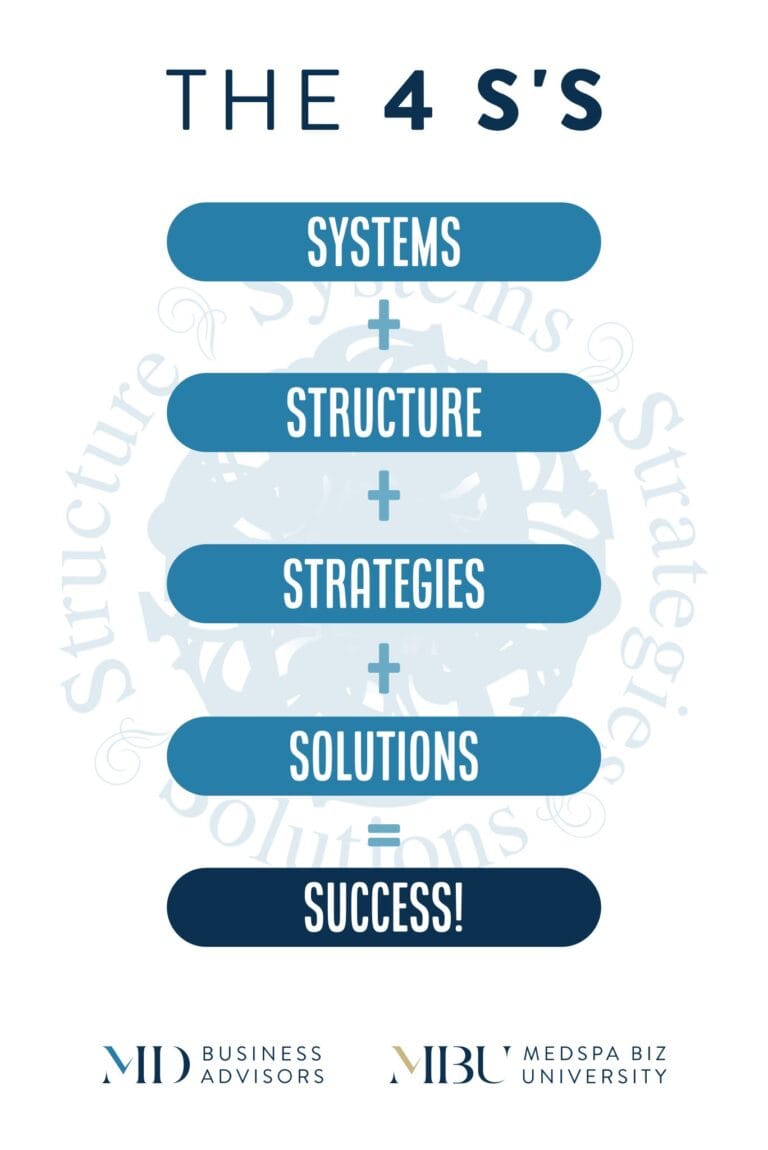
At MDBA, Strategy is one of the 4 S’s – Systems, Structure, Strategies, and Solutions – for a reason.
Strategy points all three in the same direction. A practice can have strong systems, a capable team, and well-designed programs and still grow inconsistently, because nothing defines who those programs are for, how they’re positioned, what they cost, why they’re different, or what order to build them in.
Strategy is the decision layer that makes the other three S’s add up to a business that’s going somewhere.
If your practice is busy with tactics but the results feel inconsistent, a complimentary Private MBU Growth Tour can show you how MDBA helps owners define their target market, positioning, pricing, differentiation, and growth sequence.
It’s a 30-minute, one-on-one walkthrough personalized to your stage and goals, with over $1,000 in business growth gifts.

Make 2027 the year your vision becomes an actionable plan. Join Brooke Bermingham and JR Burgess to identify your greatest growth constraint, set clear priorities, and map your first 90 days.