Business Education • Clinical Excellence
If you own a medical aesthetics or wellness practice, you spent years learning medicine through a structured curriculum. Supervised practice. Measured competence. Continuing education that never stops.
Nobody handed you a stack of YouTube videos and told you to figure it out.
So why is that exactly how most owners learn to run a business?
The way most practice owners learn business produces the same problems unstructured learning would produce in medicine. And the fix is simpler than you might think.
Every clinician-owner learned their craft the same way:
No one questions this approach in medicine. It’s the reason clinicians can be trusted with complex, high‑stakes decisions.
Now imagine a medical student told to learn by watching random videos, scrolling social media, asking peers in a Facebook group, and trying things on clients to see what worked. The idea is absurd. Nobody would trust a clinician trained that way, and no clinician would want to be trained that way.
The same clinician who would never accept unstructured clinical training learns business through:
There’s no curriculum. No sequence. No supervision. No measurement. No one with more experience catching mistakes before they get expensive.
So pricing gets figured out by trying a number. Hiring gets figured out by making bad hires. Marketing gets figured out by spending money and seeing what happens.
You’re applying a standard to your business that you would never accept for your clinical work.
This is true across medspas, functional medicine practices, regenerative medicine clinics, longevity and anti-aging practices, and other cash-based businesses. Clinical rigor on one side, guesswork on the other.
The problems unstructured learning would cause in medicine – gaps, wrong order, uncaught mistakes, and wasted time – show up the same way in business.
A clinical curriculum makes sure nothing essential gets skipped. Without one, business learning follows whatever you happen to encounter.
You might learn a lot about social media because it’s everywhere, and nothing about margin analysis, compensation design, or financial forecasting because nobody brought it up.
The result is uneven knowledge: deep in a few visible areas and missing in others. And the missing areas are often the ones that drive profitability. You can’t fill a gap you don’t know is there.
In medicine, you learn anatomy before surgery. In business, order matters just as much:
Owners who learn business randomly often do these things backward. They scale marketing before fixing conversion, hire before building structure, and add services before stabilizing the model. Each out-of-order step creates problems the next step has to work around.
In clinical training, a supervisor catches an error before it reaches the client. In business, there’s usually no one watching:
You find out the decision was wrong months later, through declining margins, an underused device, or another turnover cycle.
Clinical competence is tested. Skills are assessed. Outcomes are tracked.
In business, most owners don’t measure what matters:
Without measurement, you can’t tell whether a change worked, whether the business is improving, or where the next problem is. You rely on how things feel. And how things feel is an unreliable guide to how a business is actually performing.
Every business lesson learned through trial and error comes with a price: the margin lost on underpriced services, the cost of a bad hire, the payments on a device that doesn’t produce, and the ad spend that didn’t convert.
These aren’t tuition payments that lead to a credential. They’re losses. An owner who learns business entirely through experience can spend years and significant money discovering what a structured curriculum would teach in weeks.
If structured learning works so well, why don’t more owners seek it out for the business side? Three reasons come up again and again.
Medicine is obviously a field that requires formal education. Business often doesn’t feel that way. It seems like something smart, hardworking people should be able to figure out.
So owners don’t look for structured business education the way they would for a new clinical skill. They assume competence will come from experience. It does – eventually, slowly, and at a high cost.
Clinical training included no curriculum on pricing, financial management, team leadership, compensation, or revenue model design. Owners finished years of rigorous training without ever seeing what structured business learning looks like.
When they became owners, there was no obvious path to follow. So they defaulted to whatever information was available, which was mostly free, scattered, and unstructured.
High-achieving clinicians are used to being the expert in the room. Seeking business education can feel like going back to the beginning.
But that misreads how clinicians actually work. You seek out continuing education constantly. You train on new devices and techniques. You consult specialists. Learning from people with more experience is how you’ve always operated.
Applying that same habit to your business isn’t stepping backward. It’s the same professional standard, applied to a new area.
Structured business education isn’t a departure from your professional identity. It’s an extension of it.
Choosing structured business guidance means doing exactly what you did to become a skilled clinician: following a curriculum, learning in sequence, getting feedback from experienced advisors, measuring progress, and continuing to learn over time.
The parallels to clinical education are direct:
That’s what turns business learning from trial and error into a reliable process.
Consider a pricing decision. Through trial and error, you set a price, wait months, and learn from your margins whether it worked. With structure, you calculate the real cost of the service first, set the price to a target margin, review it with an advisor, and track the result each month. Same decision – far less risk.
You trust your clinical decisions because you were trained properly. You know what you know, how you learned it, and when to ask for help.
Structured business education builds the same confidence on the business side. You stop guessing on pricing, hiring, marketing, and finances, and you start making decisions based on frameworks, data, and experienced guidance.
Your business starts to reflect the same quality and standards you already bring to clinical care.
You built your clinical skills through structured, supervised, sequential learning. Your business deserves the same approach.
A complimentary Private MBU Growth Tour shows you what structured business education looks like inside MedSpa Biz University – the curriculum, the stage-based pathways, and the tools. It’s a 30-minute, one-on-one walkthrough personalized to your stage and goals, with over $1,000 in business growth gifts.
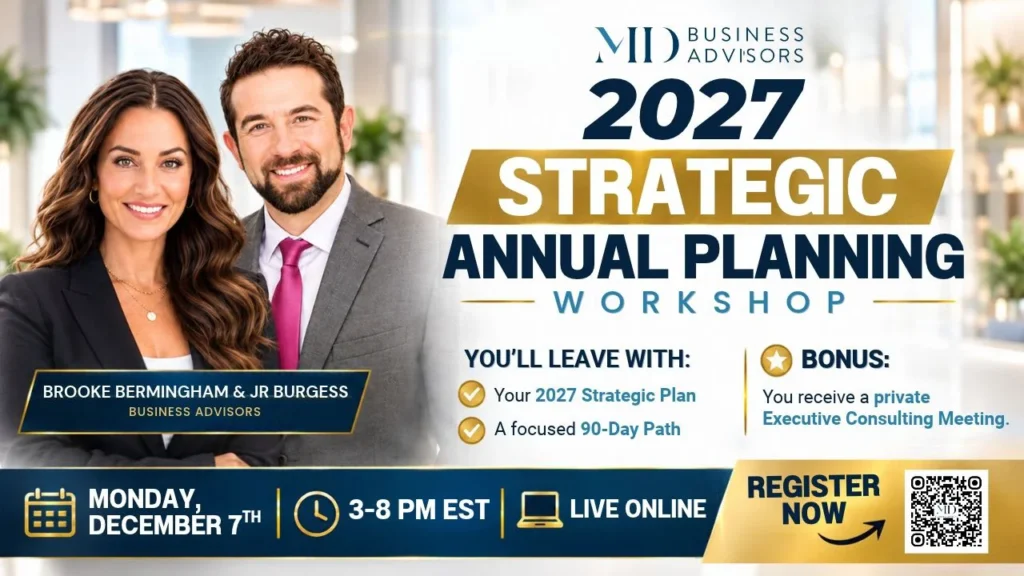
Make 2027 the year your vision becomes an actionable plan. Join Brooke Bermingham and JR Burgess to identify your greatest growth constraint, set clear priorities, and map your first 90 days.